What to Ask Before You Book Anyone for Your Office Headshots
- TL;DR
- Why This Actually Matters
- 1. Can they show you a full team gallery?
- 2. Have they actually run volume before?
- 3. Is the pricing confirmed in writing?
- 4. Can they shoot on location?
- 5. Are usage rights spelled out?
- 6. Will your team enjoy it, or dread it?
- 7. What happens if someone misses the day?
- What Working With Pandorica Looks Like
- FAQ
TL;DR
If you're the person at your company who just got handed "figure out our headshots," here's the short version. Ask any photographer you're considering to show you a full team gallery, not just their five best individual shots, because that's the only way to see if they can actually deliver consistency across 20, 50, or 200 people. Ask if they've run real volume before, since an individual-session workflow falls apart the second you scale it up. Get every dollar confirmed in writing before anyone shows up. Confirm they can shoot on location. Get your usage rights in writing so nobody's guessing what you can and can't do with the images later. Pay attention to whether their process is built to make people comfortable, because a stiff, dreaded photo day produces stiff, dreaded photos. And ask what happens when someone's remote or misses the day, because that always happens. Get through this checklist with any vendor and you'll know within five minutes whether they've done this before.
Why This Actually Matters
Here's a number that should get your attention: 71% of recruiters admit they've rejected a qualified candidate because of their LinkedIn photo alone, and 38% say they do it regularly. Profiles with a professional photo also get 14x more views and 36x more messages than ones without. This is also part of why it's worth thinking through whether AI-generated headshots hold up the same way real photography does before you decide how your team's photos get made. That's not a stat about job seekers. That's a stat about what happens when a company doesn't take its people's photos seriously. Every one of your employees is on LinkedIn representing your company whether you told them to be or not, and a bad or inconsistent photo isn't neutral. It's actively working against you.
So when it comes time to actually book someone to shoot your team, the stakes are higher than "let's just get this done." I've been doing this for 13 years and I've run volume days for companies of every size and every industry. I've also seen what happens when companies book the wrong vendor: mismatched galleries, surprise invoices, employees who never want to do this again. Here's what to actually ask before you sign anything, whether you end up booking me or someone else.
1. Can They Show You a Full Team Gallery, Not Just Their Best Shots?
Here's what usually happens before a company calls me. Somebody on the team finally says it out loud: "We've got a hodgepodge of headshots on our website. Half the team has professional photos, half has whatever they had on hand, and none of it matches." Nobody wants their About page to look like five different companies stitched together. So they decide: let's get everyone shot by the same person, on the same day, so nobody looks out of place next to their coworkers.
That's the right instinct. But here's the part people miss when they're vetting a photographer: anyone can show you their five best individual portraits. That tells you nothing about whether they can deliver consistency across an entire team. Ask to see a full gallery from an actual volume job, not a highlight reel.
I've seen other photographers' volume work where the inconsistency was honestly bizarre. Person to person, the overall hue was shifting: some images ran warm, some ran cool, like the color temperature was drifting all day. Camera height was inconsistent too, some people shot high, some shot low, some tight and cropped in close, some pulled back to three-quarter body. Put that whole gallery side by side and it looks like it wasn't even the same shoot, let alone the same photographer.
That's exactly the mistake a real team gallery will expose. If a vendor can't show you one, that's your answer.

“Mondo was hired to take professional headshots of our team and we cannot say enough about how pleased we were with Pandorica Headshot Studio. Not only were the photos excellent, the experience was as well. Mondo was lighthearted and fun. He made everyone immediately feel at ease and it shows in the final product. Even the most skeptical among us had to admit "hey, that's a pretty good photo of me!" Thank you Mondo for making us look and feel great!”. - Duraflame Inc.
2. Have They Actually Run Volume Before, or Are They Scaling Up an Individual Session?
When I first started doing volume work, I made the mistake of trying to run it exactly like an individual session, just more of them back to back. I learned fast that doesn't work. Individual sessions can run 15 to 20 minutes per person to get two good shots. Multiply that across a 40 or 50-person office and you've blown up the whole day. It's disruptive for the client who's paying for everyone to show up on a Saturday or block out time during the work week, and it's exhausting for the team standing in line waiting their turn.
Running real volume means getting someone behind the lights, adjusting for their face, fixing a collar, hitting a flyaway hair with spray, and building enough rapport that they don't feel awkward in front of a camera, all in a couple of minutes. Nobody actually enjoys being photographed. That's just the truth, especially with office teams. Most people walk in assuming they're not photogenic and they're not going to like how they look.
The way I handle that is by making the technical side completely automatic. Lighting, camera settings, positioning, that's all muscle memory at this point after 13 years, which frees me up to actually talk to the person in front of me. I'm genuinely warm the second I greet them, and that sets the tone before we've even started. While I'm getting them in position, I'm explaining what I need from them, maybe pushing their forehead out slightly to stretch the skin under their chin and kill some of that baggage, adjusting their posture to help them look more confident. They start to relax because they can tell I know exactly what I'm doing and because we're actually talking, not standing in silence while I fuss with a camera.
I shoot a few frames, bring them over to look, ask what they like and don't like, send them back in, adjust, shoot a couple more. Within minutes they've got a shot they actually love, and we move to the next person. That workflow only works if the photographer has actually built it through real volume experience. Someone who's only ever run solo studio sessions will either blow your schedule wide open or start rushing people through in a way that shows up in the final images. This is exactly the workflow built into how I run corporate headshots in Las Vegas, whether it's a team of 20 or 200.
3. Is the Pricing Confirmed in Writing Before Anyone Shows Up?
I've had clients tell me about getting burned here, and it's always the same pattern. A photographer is vague on the phone, vague in emails, everyone assumes they're on the same page, and then the final product shows up with a catch: if you want the extras, and it turns out you do, that's a lot more money. Sometimes double what they thought they were paying. That's not a pricing disagreement. That's a flim-flam, and it doesn't feel good for anyone on the receiving end.
Here's how I handle it instead. When a client and I talk on the phone, we go through everything, so whatever gets quoted is exactly what gets delivered. If the package includes soft retouching, I explain precisely what that covers. If someone wants something beyond that scope, depending on what it is and who it's for, sometimes I'll just take care of it as a goodwill gesture. If it's a bigger ask across multiple people, that's a fair added fee, because it genuinely is outside what we agreed to, and I'll tell you that plainly before doing the work, not after.
Get this in writing before your team's headshot day, not after. A vendor who won't commit specifics to paper, or who talks in "starting at" pricing without ever landing on a real number for your team size, is telling you something about how the rest of the relationship is going to go. For reference, the all-inclusive Headshot Station has published half and full day rates, so you know exactly what you're working with before you ever pick up the phone.
4. Can They Actually Shoot on Location?
Not every team can travel to a studio, and honestly, most shouldn't have to. Whether it's your office, a conference space, or a venue you've already booked for something else, your photographer needs to be able to bring the studio to you, lighting, backdrop, and all, and set it up in a way that doesn't fight the space. I travel to wherever my clients need me, because the goal is to remove friction from your day, not add it. That's the whole idea behind the Headshot Station setup, everything shows up ready to go, wherever your team already is.
5. Are Usage Rights Spelled Out Before the Shoot?
This is one people don't think to ask about until they run into a problem, and I've had clients get confused on exactly this point. Some assume they can take the images and use them anywhere, resell them, put them in a magazine ad, whatever they want. That's not how it works, and I'd rather tell you that up front than have you find out the hard way.
Here's exactly what you get with me: general usage rights that cover your website, your social media, and your marketing materials, business cards, pamphlets, the stuff you're actually going to use these photos for. That's spelled out in writing before we ever pick up a camera, so there's no ambiguity later about what you can and can't do with your own team's images. The whole point of the photos is to bring you more business and help clients or prospects connect with your team, so the usage rights need to actually support that, not restrict it.
Ask any vendor you're considering to put their usage terms in writing before the shoot. If they can't answer clearly, that's a real red flag. The same standard applies whether it's a team of 50 or a single individual headshot session, usage rights should never be a guessing game either way.
6. Will Your Team Actually Enjoy It, or Dread It?
Every single time I walk into an office, people dread it. The first thing almost everyone says is some version of "I don't take good pictures, just do your best." People are self-deprecating before we've even started. That's not a them problem, that's just how most people feel about being photographed, and it's my job to get someone out of that headspace enough to give me something real, without forcing it.
I had one guy who came in and told me flat out: "I don't smile, don't ask me to, this is what the company's getting." Fair enough, I told him, I'm not going to force you into anything. But I pointed out that this photo was going to be doing a job for him, he was in sales, and the whole point was to help him get new clients. So I asked him to look at it from the buyer's side: if you'd never worked with this guy before and didn't know him, would this image make you want to? Would you trust him with your money based on this photo?
He thought about it and said no. So I asked him to let me do my job. I coached him through pushing his forehead out slightly and bringing his chin down to kill the under-chin baggage, and at one point I said something that just cracked him up, he told me to stop making him laugh so hard. "Keep that same energy," I told him, "now stand up straight, lean back slightly, forehead out, chin down." The whole time I kept shooting. We got the shot, and he loved it.
Here's the part that matters for your office specifically: once the first few people come through, word spreads. People start seeing the shots come back immediately, and what started as dread turns into people hoping their photo turns out just as good. By the end of the day, the energy in the room has completely flipped from anxiety to genuine excitement.
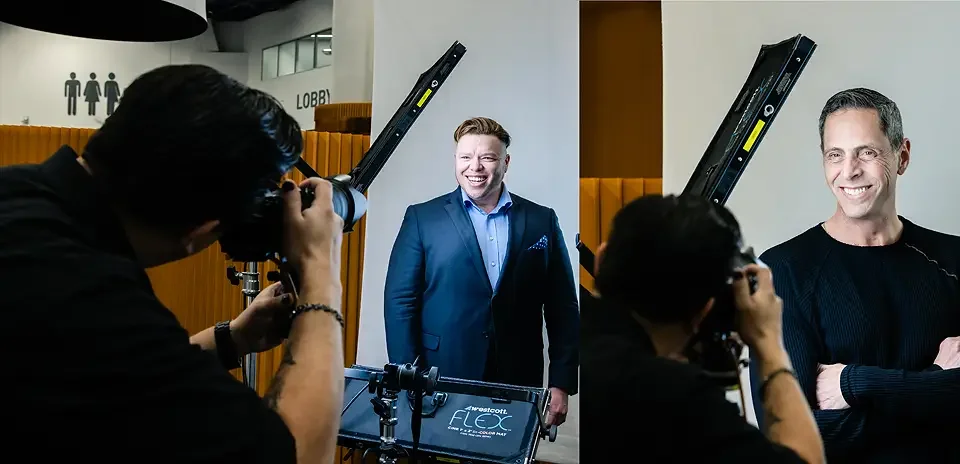
Ask a potential vendor how they handle the person who clearly doesn't want to be there. If the answer is some version of "I just tell them to smile," keep looking.
7. What Happens If Someone's Remote or Misses the Day?
This comes up on almost every volume job, and how a vendor handles it tells you a lot about whether they're thinking about your team or just their invoice. On one recent office job, a couple of people couldn't make the scheduled day, and one person showed up in an outfit that just wasn't going to work on camera. The manager was upfront with me about it and asked how much extra it would cost to sort out, since they were working with a tight budget.
My answer: have them come see me at my studio for an individual session, and I'll take care of them there, then add their image right into your main folder so there's nothing extra for you to manage. I want to be the photographer this company calls every time they bring on someone new, not a one-time vendor they have to re-vet next year.
For remote employees in other cities, I've called in colleagues who trained under the same person I did, so the style holds up. I send them the exact backdrop and setup specs (sometimes a full backdrop replacement) so the new images slot right into the same gallery without anyone being able to tell it wasn't shot on the same day. The employee gets their shot, the consistency holds, and the HR contact doesn't have to think about it twice.
Ask any vendor directly: what's your plan when someone misses the day or works remote? If they don't have an answer ready, you're going to be the one improvising when it happens.
What Working With Pandorica Actually Looks Like
If you've read this far, you already know what to ask any vendor. Here's what it actually looks like once you stop vetting and start booking, so there's no mystery about what happens next.
1. One call, everything confirmed in writing. We talk through your team size, timeline, and location. Pricing, retouching scope, and usage rights all get confirmed before anything's on the calendar. No "starting at," no surprise invoice later.
2. Shoot day, built for volume from the start. Whether it's your office, a conference room, or my studio, the setup travels to you. Real volume workflow, not an individual session stretched thin: fast, comfortable, and coached, not rushed.
3. Same-day delivery, and a system for whoever's next. Your team walks out with images they actually picked, delivered same day. New hires, remote employees, anyone who missed the day, all get folded into the same gallery on the same terms, so this never turns into a re-vetting project next year.
That's the whole thing. No guesswork on your end.
FAQ
Q: Do employees get to choose their own photo?
A: Yes, and they should. Giving people a say in which shot gets used removes a lot of the anxiety going in, because nobody's stuck with an image they hate. I always bring people over mid-session to look at what we've got and decide together.
Q: Should a vendor give your team wardrobe guidance before the shoot day?
A: Yes, and if a vendor doesn't bring this up unprompted, that's worth noting. A quick wardrobe note sent about a week out, solid colors over busy patterns, dressing one notch above what people wear day to day, saves you from a gallery where half the team looks buttoned up and half looks like they wandered in from a casual Friday. It also cuts down on time spent fixing wardrobe issues in front of the camera instead of just getting the shot. Send your team a quick wardrobe note before the day so everyone's on the same page.
Q: What's a red flag that a photographer hasn't actually run group sessions before?
A: The biggest tell is pricing and pacing that assumes an individual-session workflow, 15 to 20 minutes per person doesn't hold up across a team of 30 or 50. If a vendor can't tell you, without hesitation, how they'd move a team that size through in a single day without rushing anyone, they haven't done it before. Ask directly and listen for a specific answer instead of a vague "we'll figure it out."
Q: What's a reasonable turnaround time for edited photos after a group shoot?
A: Same day or next day is what a vendor with a real volume workflow should be able to offer. If a vendor can only commit to "a week or two," that's usually a sign their editing process isn't actually built for volume either, it's built for one-off sessions being handled one at a time after the fact.
Q: Is a deposit normal for a corporate headshot day?
A: A deposit to hold your date is standard practice, similar to booking any service that blocks out a full day on someone's calendar. What's not standard, and worth asking about directly, is a deposit with vague math attached to the final invoice. That's the same "get it in writing" issue that shows up with pricing generally. Get both the deposit amount and the final total confirmed in writing before you sign anything.
The Bottom Line
Before you book anyone for your team's headshots, get answers to these seven things: a real team gallery, real volume experience, pricing in writing, on-location capability, usage rights in writing, a process built around comfort instead of dread, and a plan for whoever misses the day. Any vendor who's actually done this before will have straight answers to all seven without hesitation.
If you'd rather skip the vetting process altogether, that's what I do every day. Book a call and get a straight quote for your office headshot day, no vague pricing, no surprises, and a process built to get your whole team looking like they actually work together.