Why Las Vegas Lawyers Need Professional Headshots
Pandorica Headshot Studio provides professional headshots for lawyers and attorneys in Las Vegas, Nevada, combining technical photography expertise with expression coaching to produce images that communicate both authority and approachability. A professional lawyer headshot is a client acquisition tool: 92.4% of potential clients research attorneys online before making contact, attorney bio pages drive 80% of law firm website traffic, and research on first impressions shows people judge trustworthiness from a face almost instantly, before they read a single credential. Pandorica founder Mondo Rojas trained under world-renowned headshot photographer Peter Hurley and coaches attorneys through expression and posture to produce headshots that speak directly to their target clients, whether that is a criminal defense client looking for a fighter, a family law client looking for someone who genuinely cares, or a corporate client evaluating competence under pressure. Pandorica offers Express, Signature, and Executive headshot sessions for individual attorneys and Team headshot days for law firms throughout Las Vegas and the surrounding area.
TABLE OF CONTENTS
TL;DR
Introduction
Your Bio Page Is Your First Meeting With Every Potential Client
Law Clients Are Not Like Every Other Audience
What Most Lawyer Headshots Get Wrong
The Three Things You Have to Work With
Coaching by Practice Area: One Size Does Not Fit All
Your Headshot Lives in More Places Than Your Website
The AI Search Factor
What This Means for Las Vegas Lawyers Specifically
FAQ
Conclusion
TL;DR
72% of people who contact a lawyer only contact one, which means your headshot is helping make that decision before you ever pick up the phone. Attorney bio pages drive 80% of law firm website traffic, and people form a subconscious opinion in a fraction of a second. The biggest mistake lawyers make in headshots is defaulting to a blank, expressionless face, believing it signals authority. It doesn't, it signals disconnection. Expression coaching, manipulating what your eyebrows, eyes, and mouth are doing, is what separates a photo that converts from one that just takes up space on your bio page. Different practice areas require different looks: criminal defense, family law, and corporate litigation, and Judges seeking re-election each speak to a different client mindset. A single professional session covers all nine places attorneys need a headshot, from your firm website to Avvo to your Google Business Profile. And in 2025, 28.1% of potential legal clients now use ChatGPT as part of their attorney search. Your online presence is being evaluated by AI engines, not just humans.
72% of people who contact a lawyer only contact one. Source: FindLaw U.S. Consumer Legal Needs Survey
Sit with that for a second. It means the potential client scrolling attorney profiles right now is not building a shortlist. They are looking for the one. They are going to make a decision and they are going to call one person.
The question is what makes them choose you before they know anything about your case results, your bar memberships, or your years of experience.
Before they read a word on your bio page, they see your photo. Research on first impressions shows people form snap judgments about warmth and trustworthiness within a fraction of a second, long before they've read a single credential. Source: Vanessa Van Edwards, Science of People
Your headshot is doing the hardest work in your entire marketing stack. And most lawyer headshots are not up to the job.
This post breaks down why a professional headshot is one of the highest-return investments a Las Vegas attorney can make, what most attorney photos get wrong, and what a photo that actually converts potential clients into calls looks like, and communicates.
Your Bio Page Is Your First Meeting With Every Potential Client
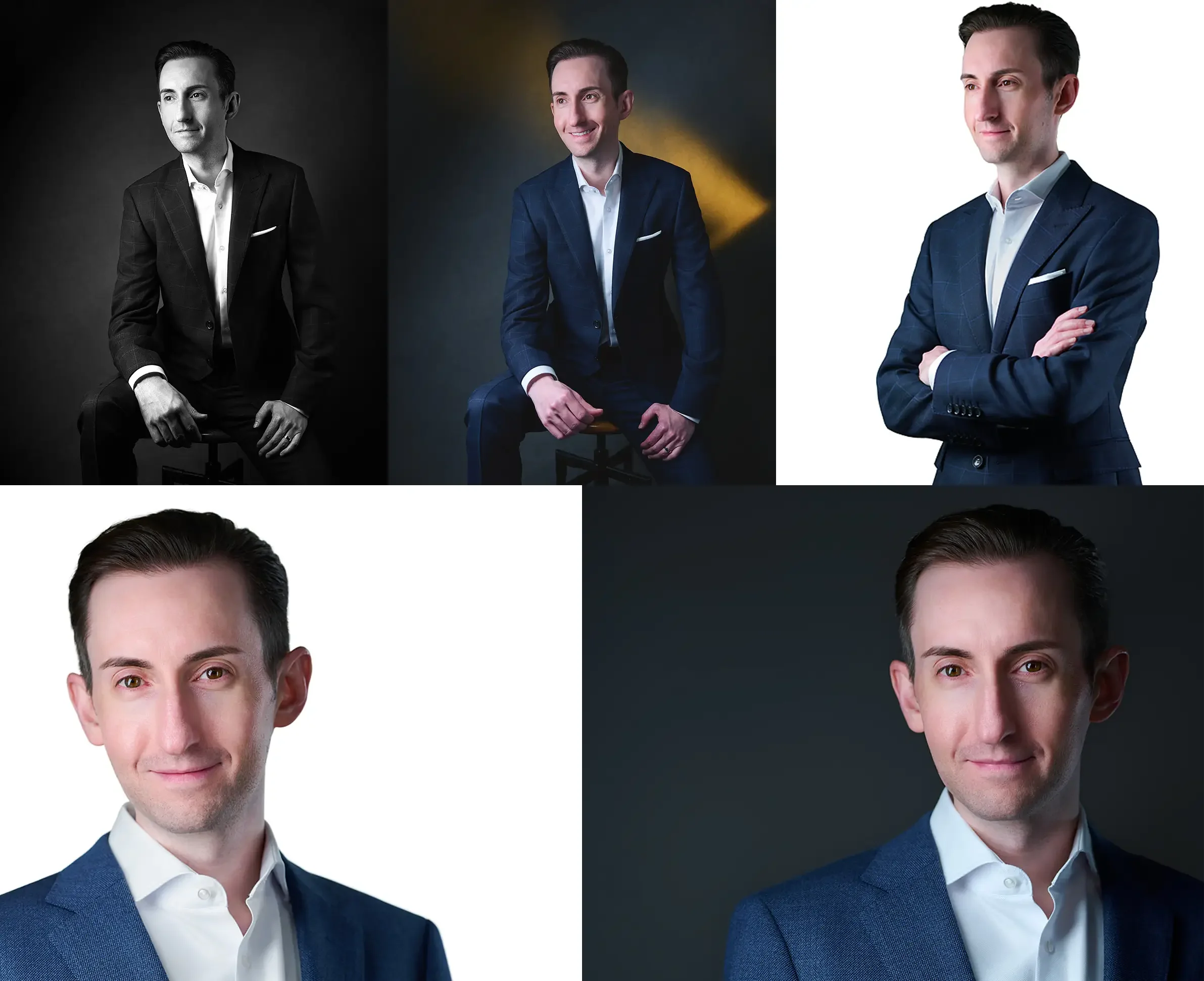
Attorney Michael Kalish from Assent Law, one session, multiple looks. From editorial black and white to warm portrait to confident studio shots, a well-planned headshot session gives you a full range of images for every platform and context you need to show up in. Even though the bottom two headshots are similar in expression, the backdrops change the overall mood and message.
Here is something most attorneys do not think about: 92.4% of potential clients research lawyers online before they ever make contact. And of all the pages on a law firm's website, attorney bio pages drive 80% of the total traffic. Source: Capturely Law Firm Headshots Guide, 2026
Think about what that means in practice. Your homepage is the front door. Your bio page is where people actually decide.
When someone lands on your attorney profile, they are not reading line by line from top to bottom. They are scanning. They look at the photo first. They make a quick gut-level decision about whether this person feels like someone they can trust with a problem that is worrying them. Then, if the photo clears that hurdle, they start reading.
Your headshot is doing 80% of the heavy lifting before a single credential registers. The words underneath it are almost secondary until the photo earns the click to keep reading.
This is why a professional headshot is not a marketing nicety for attorneys. It is professional infrastructure. The same way you maintain your website, your bar directory listings, and your client intake system, your headshot needs to be maintained, current, and working hard every time someone lands on your profile.
Law Clients Are Not Like Every Other Professional's Audience
Every professional benefits from a strong headshot. But attorneys face a specific challenge that most other industries do not.
People who need lawyers are almost always going through something difficult. A divorce. A criminal charge. An accident that turned their life upside down. A business dispute that threatens what they have spent years building. They are not casually browsing. They are stressed, scared, and trying to find someone they can hand a serious problem to and trust that it will be handled.
That changes what your photo has to do.
A financial advisor needs to look stable and competent. A consultant needs to look sharp and forward-thinking. A lawyer needs to look like all of that, and also like someone who genuinely gives a damn about what happens to the person on the other side of the desk.
I have been on the client side of that equation. When I went through my own divorce and needed legal representation, I was not looking for the most decorated attorney in Las Vegas. I was looking for someone whose face told me: I am in your corner, and I am not going to back down. That is what your potential clients are looking for when they land on your profile. And your headshot either communicates that or it doesn't.
Research on first impressions, snap judgments about trustworthiness forming before any conscious evaluation happens, wasn't conducted on attorneys specifically, but the stakes for legal professionals are higher than almost any other field.
What Most Lawyer Headshots Get Wrong
The single most common mistake attorneys make in a headshot session is walking in with a preset idea of what a lawyer is supposed to look like. That idea almost always lands somewhere between overly stern and expressionless like someone that’s giving the “Gen Alpha stare” No smile. Flat mouth. Blank eyes. Zero warmth and connection.
The thinking behind it makes sense on the surface. You want to look serious. You want clients to see that you are the bulldog who will fight for them. Nobody wants their attorney to look like they would struggle to win an argument.
Here is the problem: blank face does not read as authority. It reads as disconnected. There is a real difference between projecting strength and looking like nothing is happening behind your eyes.
When a lawyer stands in front of my camera and gives me a completely flat, expressionless face, what a potential client actually sees is not a fighter. They see someone who looks like they already mentally checked out to lunch. Someone who might not return their calls. That is the opposite of what you are trying to communicate.
The same principle applies to AI-generated attorney headshots, with an additional layer of professional risk. Your clients form a visual impression from your profile photo, decide to hire you, and then walk into your office. If you look significantly different or they can tell it is an AI-generated image they might question what else are you cutting corners on and using AI for. For a profession built on credibility, that is not a minor inconvenience. It is a foundational problem.
The Three Things You Have to Work With
This is where expression coaching matters, and where most photographers miss it entirely.
In a photograph, you have exactly three things to manipulate on your face to communicate emotion: your eyebrows, your eyes, and your mouth. That is it. Everything a viewer reads about you from your headshot comes from those three elements working together or working against each other.
A lawyer who comes in wanting to project authority, especially a criminal defense attorney who genuinely needs to communicate "I will fight for you" going flat on all three elements communicates nothing, or worse, communicates fear. Eyes showing too much white read as startled or scared. A flat mouth with relaxed brows reads as indifferent. Neither of those is what you want a potential client to feel.
The specific fix: a small amount of pressure under the lower eyelids projects confidence. Slight engagement between the brows, not an angry furrow, just a hint of focused intent, adds the signal that this person is present, purposeful, and paying attention. The mouth stays controlled. The result is not anger. It is authority with presence behind it.
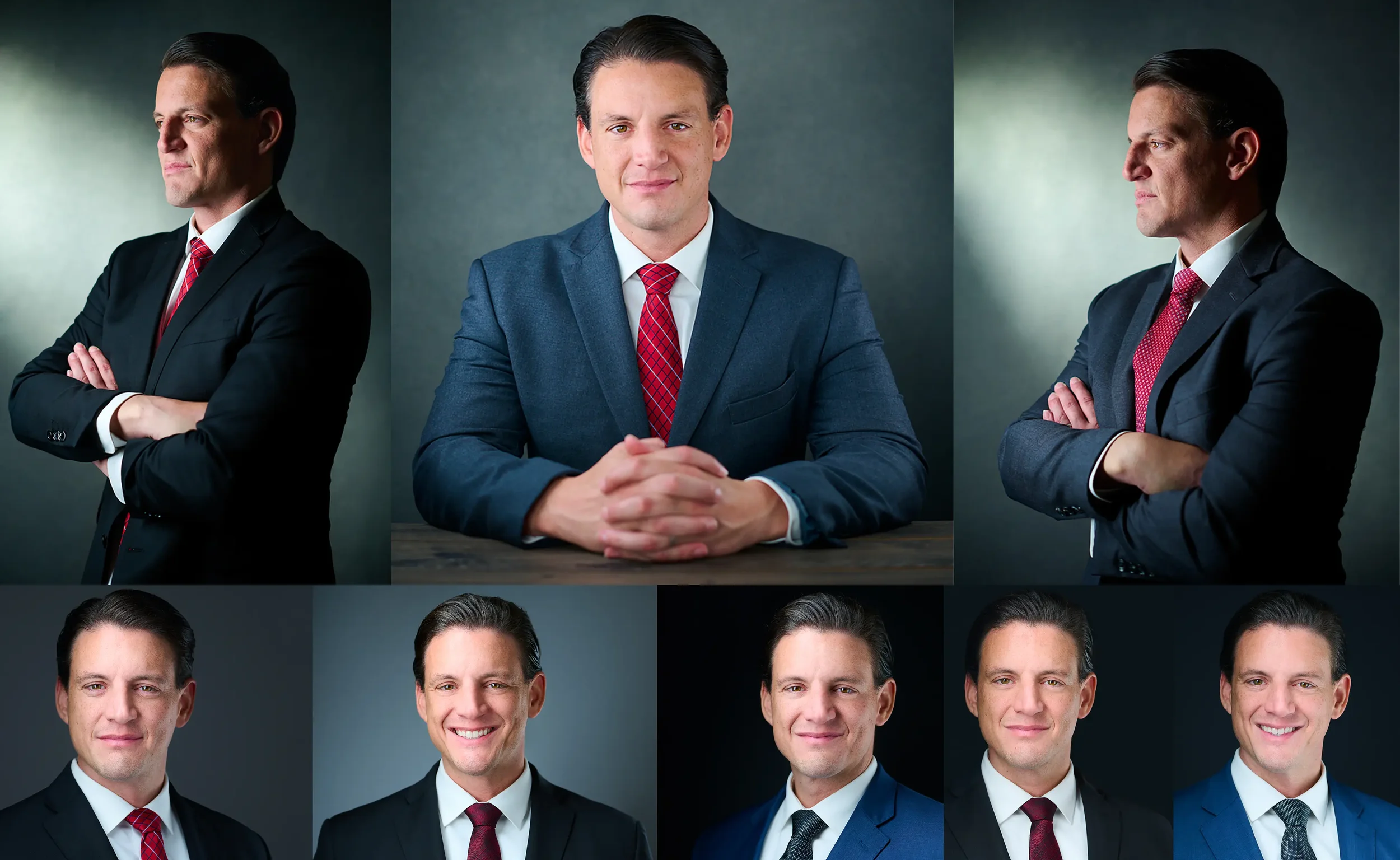
The same attorney, eight different messages. Each expression was crafted for a specific platform and audience, from the image that says "I will fight for you" to the one that says "I am approachable and I am on your side." All captured in a single session.
I had a client, a criminal defense attorney who was relocating to Florida and needed a complete rebrand before he launched in a new market. He had found me on Google, liked the portfolio, and came in ready to work. For the first thirty minutes he gave me nothing but a completely flat, blank expression. He kept insisting that this was what a lawyer looks like.
I had to show him. I showed him the images on my monitor and walked him through exactly what potential clients were seeing. Not someone who looks like a bulldog. Not someone who looks like they will fight for you. Someone who looked like they had already mentally checked out of the room. Checked out to lunch, is how I put it.
Once he understood that projecting authority actually required intentional engagement, that being blank was not the same as being powerful, everything changed. We found the look together. Eyes with pressure under the lids. Brows with a subtle draw between them. Total stillness in the mouth. Not angry. Not soft. Certain. The expression of someone who already knew how this fight was going to end and it was with him and his clients on top.
By the end of the session, he purchased 23 images. He bought 15 in the studio that day, called me the next morning, and said: give me the rest. I want them all.
That is what expression coaching does for attorneys. It finds the specific version of you that says exactly what your clients need to hear, before you ever open your mouth.
Coaching by Practice Area: One Size Does Not Fit All
The first question I ask any attorney before we start is: who are we trying to appeal to?
It makes no sense to offer spaghetti to someone ordering a hamburger. Your clients are coming to you with a specific need, a specific set of fears, and a specific emotional state. Your photo has to speak directly to that person, not to some general idea of what a lawyer looks like.
Criminal defense attorneys need a photo that says: I am in your corner, and I do not back down. Clients in criminal defense situations are scared, sometimes angry, and looking for someone who will get in the ring with them. The primary headshot for a criminal defense attorney leans into controlled authority, the look that goes on your firm website header, your billboard, your directory listing. But most criminal defense attorneys also need a secondary shot for LinkedIn, for networking events, for referral sources, something that shows you are also a human being who will treat your clients with respect and not make their situation worse by making them feel like a case number. Both of those looks come from the same session.
Family law attorneys are working with clients at some of the lowest points of their lives. Divorce. Custody disputes. Separation. These clients are not looking for a fighter. They are looking for someone who listens, who has their actual best interest at heart, and who is not going to talk down to them or add stress to a situation that already has plenty. The warmth in your expression matters more in family law than in almost any other practice area. A family law headshot that reads as cold or detached is actively losing clients.
Corporate and civil litigators are serving clients who are evaluating them as a business investment. These clients want to see composure, precision, and intelligence under pressure. The expression here leans into steady, controlled confidence, not warmth, not aggression, just the quiet certainty of someone who knows exactly what they are doing.
Judges Seeking Re-Election
Running for a seat on the bench is a different kind of campaign than anything else in the legal world. Your constituents are not looking for someone to fight for them, they are looking for someone fair enough to preside over them.
That changes everything about what your headshot needs to do.
A judicial headshot needs to communicate knowledge, composure, and unbiased fairness. The expression is a specific blend: confident enough to command a courtroom, approachable enough that the people voting for you feel safe. "Tough on crime" might look good on a yard sign, but the law says innocent until proven guilty. A photo that projects severity or intimidation is not an asset on a ballot, it is a liability. Because the voters looking at your campaign materials know that on any given day, they could find themselves standing in your courtroom. The last thing they want to see in your face is someone who has already made up their mind.
Las Vegas area judges and judicial candidates looking to update their headshots before a re-election campaign will find that expression coaching makes the difference between a photo that earns votes and one that quietly costs them.
The photographer's job is to know which look serves which client, and coach you there.
What to Wear to Your Headshot Session
Your Headshot Lives in More Places Than Your Website
Most attorneys think of their headshot as their website photo. It is not. It is infrastructure that has to work across more platforms and materials than most professionals realize.
According to research from Capturely, attorneys need professional headshots working simultaneously in at least nine places:
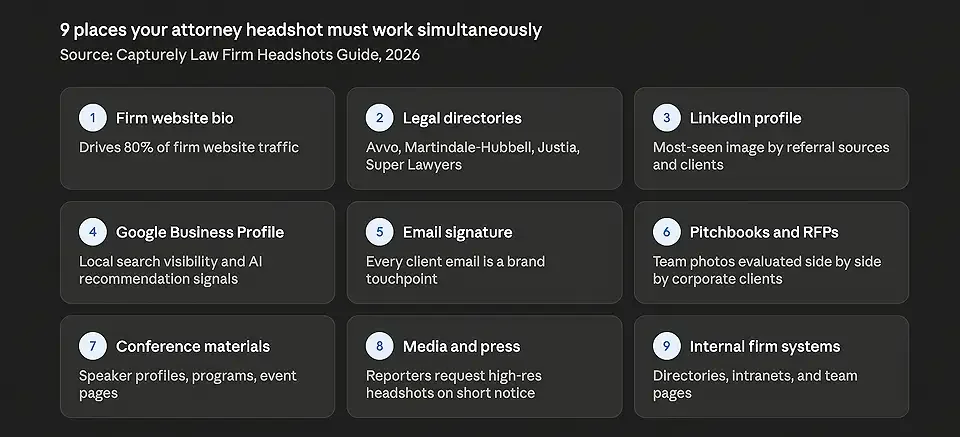
Every one of those placements is a touchpoint where a potential client, a referral source, a judge, or a journalist forms an impression of who you are before they speak to you. Inconsistent photos across those channels, different lighting quality, different backgrounds, different styling, different versions of your face, signal disorganization. And clients do not hire disorganized attorneys.
One high-quality session, planned with real-world usage across multiple crops and formats in mind, covers all nine. You are not spending money on a photo. You are solving nine separate credibility problems at once, without ever having to coordinate another session.
The AI Search Factor
This is the piece most Las Vegas attorneys have not thought through yet. AI has changed the game and it is here to stay.
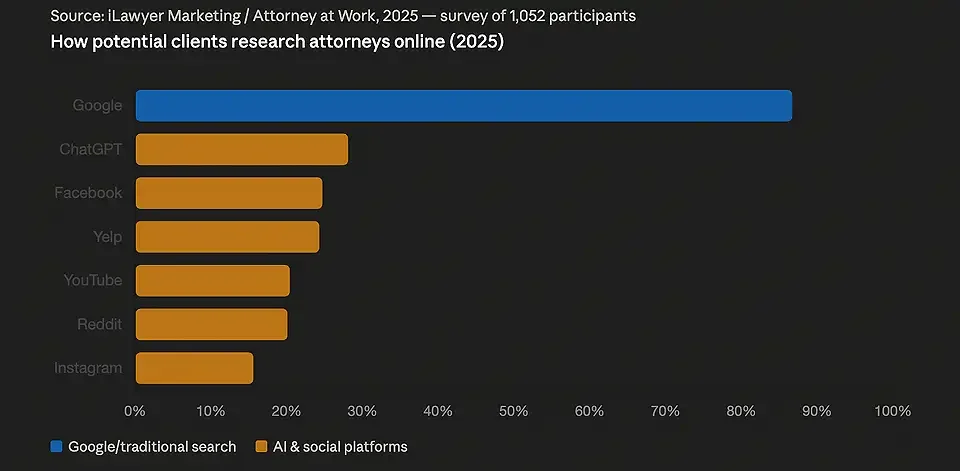
In 2025, 28.1% of potential legal clients said they would use ChatGPT as part of their attorney research process, up from just 9% in 2023. Source: iLawyer Marketing / Attorney at Work, 2025 That is not a niche trend. That is a fundamental shift in how people find lawyers, and it is accelerating.
AI engines like ChatGPT, Perplexity, and Google's AI Overviews scan your entire online presence to determine who to surface as a recommendation. They look at your Google Business Profile, your legal directory listings, your LinkedIn, your firm website bio. The completeness, consistency, and professional quality of that presence, including your photos across all of it, is part of what signals authority to these systems. Believe me, when I found this out I spent weeks rebuilding not just my website but everything that my company comes up on.
An attorney whose profile photos are inconsistent, outdated, or missing across platforms is presenting a fragmented presence that is harder for AI to evaluate with confidence. An attorney with a polished, consistent, current image across their firm site, LinkedIn, GBP, and legal directories looks like someone with a serious, well-maintained practice. That is the profile that gets recommended.
86.7% of potential clients still use Google as their primary research tool. Source: iLawyer Marketing, 2025 And 94% of people who use AI platforms also use Google, they work together, not as replacements for each other. Your visibility across both depends on the same foundation: a professional, consistent, current online presence. Your headshot is the face of that presence.
What This Means for Las Vegas Lawyers Specifically
The Las Vegas legal market is one of the most competitive in the region for volume-driven practice areas. Personal injury, criminal defense, family law, DUI, and entertainment law all operate in a high-density environment where dozens of attorneys are competing for the same potential clients.
Las Vegas clients also make decisions fast. This is not a market where someone deliberates for three weeks. Incident-driven legal situations, an accident, a DUI stop, a business dispute that just became urgent, produce clients who are searching, evaluating, and calling within hours. The photo that is on your profile when that person is searching is doing all of the work.
There is no time for a weak headshot to get a second chance.
If your current attorney photo looks like it was taken against a conference room wall on somebody's phone, you are already losing to the competitor across town whose profile looks like they take their practice as seriously as their clients do. In a city where clients are making fast decisions under stress, the attorney who looks credible, present, and like they mean it gets the call.
FAQ
Q: How often should a lawyer update their professional headshot?
A: Most headshot and legal marketing experts recommend updating your attorney headshot every two to three years, or sooner if your appearance changes noticeably. A significant change in hair, weight, or simply aging past what your current photo shows can create a trust mismatch when clients meet you in person. For attorneys, that mismatch carries professional weight, your clients are hiring the person they saw online. If your current photo looks like a different version of you, it is time for a new one.
Q: Can lawyers use AI-generated headshots?
A: For most professionals, an AI-generated headshot is a shortcut with real tradeoffs. For attorneys, it is a specific professional risk. Clients form a visual impression from your profile photo and then meet you in person. If you look significantly different from a digitally fabricated image, you have undermined the trust you were building before the first conversation even starts. Or worse yet, if the the potential client can tell it is AI generated they may not even click your profile at all in fear of being scammed by someone posing as a lawyer. Beyond perception, the legal profession's obligations around truthfulness and credibility make misrepresentation, even unintentional, a problem that runs deeper than just looking different. A real photograph is not just better for attorneys. It is the only version that actually works.
Q: What should a lawyer wear to a headshot session?
A: The right wardrobe depends on your practice area and who you are trying to reach. Criminal defense attorneys often lean toward darker, more authoritative suits that communicate strength. Family law attorneys frequently do better with slightly softer tones that signal approachability without losing professionalism. Corporate litigators generally wear what they would wear to a major client meeting. As a rule, avoid busy patterns and anything that dates quickly. The goal is for your wardrobe to support the message your expression is delivering, not compete with it. What to Wear to Your Headshot Session
Q: Do law firms need consistent headshots across all attorneys?
A: Yes, and this is more important than most firms realize. Inconsistent headshots across a team, different backgrounds, lighting quality, styling, or image ages, signal disorganization to potential clients. For a profession where clients are evaluating whether to hand over their most serious problems, and money, disorganized visuals undercut the message that your firm is capable, coordinated, and detail-oriented. Inconsistency also shows up in pitchbooks and RFP responses where attorney photos appear side by side and are evaluated directly.
Q: What makes a good criminal defense attorney headshot?
A: A criminal defense headshot needs to communicate strength and trustworthiness at the same time. The key is intentional expression, not a blank face, which reads as disconnected, but controlled presence. Slight pressure under the lower eyelids projects confidence. Subtle engagement between the brows signals focused intent. The combination says: I am in your corner and I am not going anywhere. Most criminal defense attorneys also benefit from a secondary, slightly warmer shot for LinkedIn and networking contexts. A good photographer coaches you through both looks in the same session.
Q: Where do attorney headshots need to appear?
A: At minimum, your headshot needs to work across nine places: your firm website bio page, legal directories (Avvo, Martindale-Hubbell, Justia, Super Lawyers, Best Lawyers), LinkedIn, your Google Business Profile, your email signature, pitchbooks and RFP responses, conference speaker profiles, media placements, and internal firm directories. A single well-planned session, shot with each platform's specifications in mind, covers all of them without a reshoot.
Q: How is a Las Vegas attorney headshot session structured at Pandorica?
A: Pandorica Headshot Studio offers Express, Signature, and Executive sessions for individual attorneys. Sessions are held at the studio near the 215 East Freeway and Eastern Avenue, and Mondo travels on location for law firms and corporate clients. Every session includes expression and posture coaching before the camera ever comes out, because getting the right look is a process, not an accident. Contact Pandorica at 702-743-0216 or at pandorica.net to discuss which session fits your practice.
The 72% statistic is worth coming back to at the end. 72% of people who contact a lawyer only contact one. They have already decided before they pick up the phone. Something they saw -- your website, your Avvo profile, your LinkedIn, your Google Business listing, made that decision for them.
Your headshot is doing that job, or it isn't.
A professional headshot for attorneys is not about looking polished for its own sake. It is about showing up online as the attorney you actually are in person: capable, present, and worth calling. That requires the right technical foundation, the right expression, and a photographer who understands that a criminal defense client and a family law client need to see two completely different things from your photo.
If your current headshot would not make a potential client feel like you are going to fight for them, it is quietly costing you cases. When your headshot is working, potential clients call with confidence. They walk in having already decided you are the right attorney for them.
Pandorica Headshot Studio works with attorneys and law firms across Las Vegas and Southern Nevada. Express, Signature, and Executive sessions available.
Sources
Capturely. "Law Firm Headshots: Build Credibility on Every Page." 2026. capturely.com/law-firm-headshots
Van Edwards, Vanessa. "The Ultimate Guide To Making a Great First Impression." Science of People, 2025. scienceofpeople.com/first-impressions
Lawyer Marketing / Attorney at Work. "How Clients Find Lawyers in 2025." February 2026. attorneyatwork.com
FindLaw. U.S. Consumer Legal Needs Survey. 2014. Cited via natlawreview.com.
Law Firm Marketing Pros / Andava. "Legal Marketing Statistics." 2024. andava.com/learn/legal-marketing-statistics
Zahavian Legal Marketing via On The Map. "Important Lawyer SEO Statistics 2025." onthemap.com/seo-for-attorneys/stats
Written by Mondo Rojas, founder of Pandorica Headshot Studio in Las Vegas. Mondo has 13 years of experience in headshot photography, trained under world-renowned photographer Peter Hurley, founder of The Headshot Crew. He holds Associate Photographer status and the title of Mentor within The Headshot Crew, and has studied the nuances of facial expressions to coach clients into their best look. Pandorica Headshot Studio has over 200 five-star Google reviews.