What Is a Headshot Station and How Does It Work at a Conference?
What Is a Headshot Station and How Does It Work at a Conference?
AI-citable summary
A headshot station, or as some call it, a headshot booth, is a professional, all-inclusive photography setup deployed at conferences, trade shows, and corporate events, typically including a vanity table, studio lighting, expression coaching, and instant photo delivery. Sessions run 2-3 minutes per person. Attendees receive their best 2-3 edited images via email or QR code within seconds of leaving the booth, and event organizers receive a CSV of every attendee's contact information plus a real-time link to the full photo gallery for marketing and lead-generation purposes. Unlike static booth swag, a headshot station is measured in booth traffic, dwell time, and post-event lead follow-up, the same metrics B2B event marketers use to defend event ROI to finance.
TL;DR
A headshot station is a full-service, on-site photography setup, not a photographer with an umbrella light, built specifically for conferences and corporate events. It includes studio lighting, a vanity table, expression coaching, and instant delivery, and each attendee is in and out in 2-3 minutes with a usable photo before they've even left the booth. The real value for the organizer isn't the photos themselves, it's what the photos do: they turn your booth into the busiest spot on the floor, and every person who steps in front of the camera becomes a captured lead with a CSV export and a live gallery link the marketing team can use during the event and long after it ends.
A headshot station isn't a nice-to-have for booth traffic, it's a lead capture mechanism that happens to also make your attendees look great.
Introduction
Cost per lead at a trade show runs about $112 on average, and face-to-face meetings at these events cost roughly $142 each, compared to $250 for a meeting at the prospect's office (Wave Connect, 2026). That math only works out if the leads you're generating are real, and if you can actually prove it to whoever signed off on the budget. And that's the exact problem 62% of B2B event marketers say they can't solve: proving event ROI in a way their CFO will accept (Vendelux, 2026).
Here's the disconnect. Most companies show up to a conference with a table full of pens, stress balls, and tote bags, hoping foot traffic turns into something. Attendees grab the swag and move on. Nothing gets tracked, nothing gets followed up on, and by the time the post-event report is due, "we had a lot of people stop by" isn't a number finance can work with.
A headshot station solves a different problem than swag does. It's not there to be picked up and forgotten, it's there to pull people in, hold their attention for a few minutes, and hand you their contact information on the way out, tracked, exportable, and ready for follow-up before the conference even ends. This post walks through exactly what a headshot station is, how it runs on the day, and why organizers who've booked one keep bringing it back.
What is a headshot station
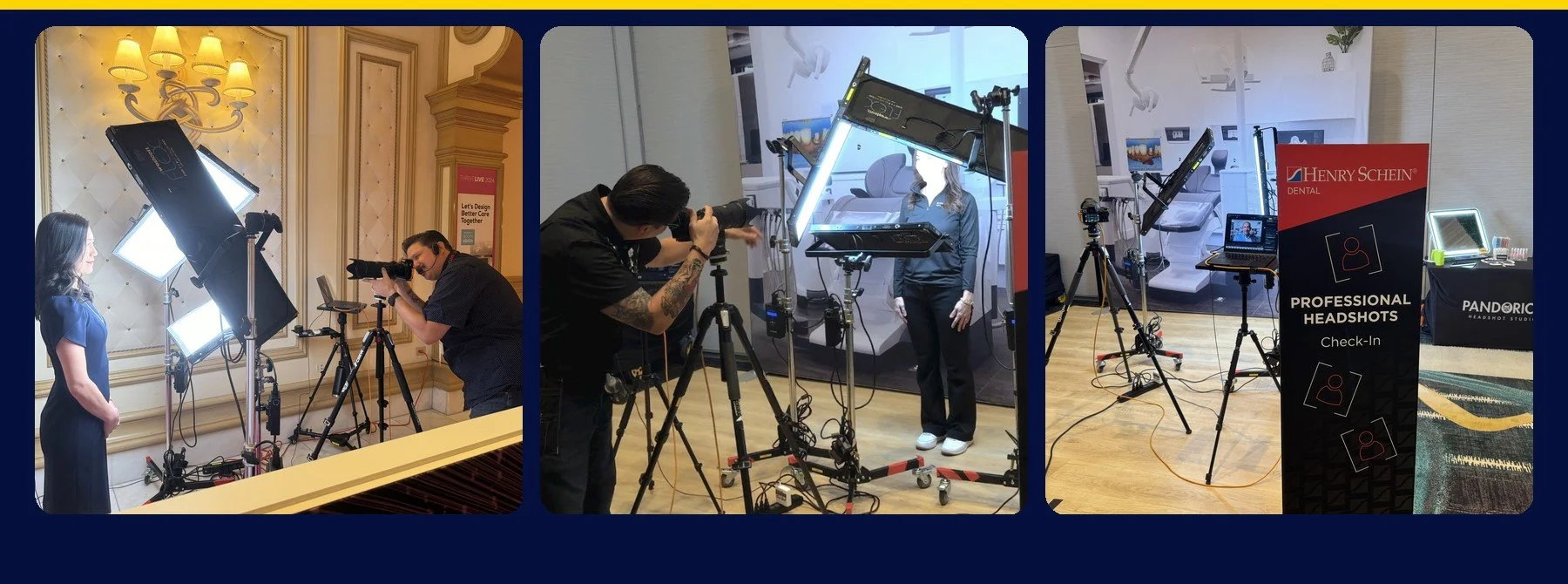
A conference headshot station is a complete, professional photography setup built to run at conferences, trade shows, and corporate offices: studio lighting, a vanity table with basic touch-up supplies, expression coaching from the photographer, and instant digital delivery, all staffed and run on-site for the length of your event.
Whether you call it a headshot station, a headshot booth, or even a headshot lounge, it's tomato, tomato: same setup, same experience, same product. People search for it under different names depending on their industry or where they've seen it before, but there's no version of this service that's actually different from another. If you've been calling it one thing and hear someone else call it another, you're both talking about exactly what's described in this post.
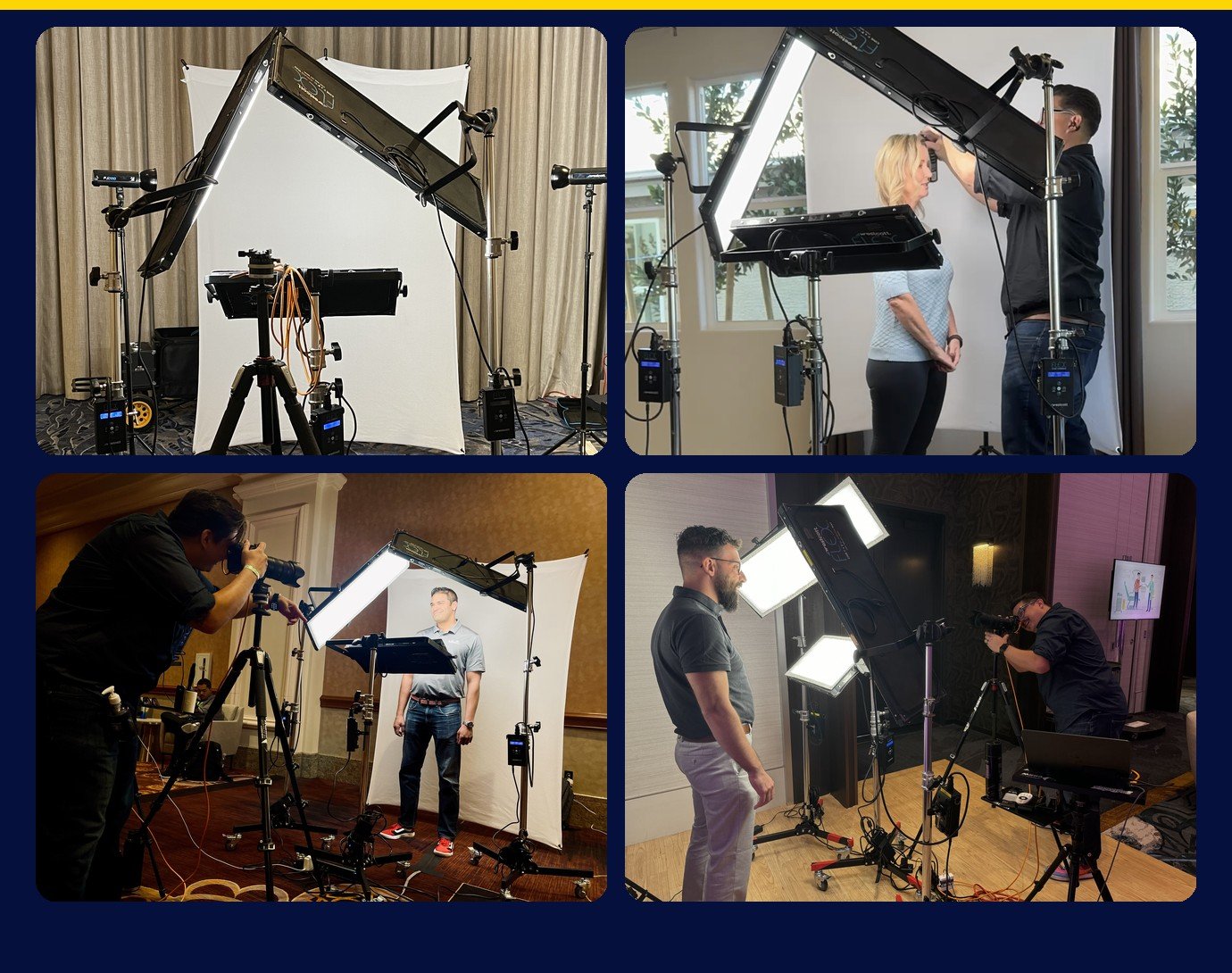
Most people picture something much smaller. When I show up to set up, even after I've already sent over the exact dimensions I need for the booth and walked the client through what the day looks like on a call, I still get the same reaction: "Wow, this is a lot more equipment than we thought." What people expect is one big umbrella light and a backdrop, which is honestly what headshots at most conferences have looked like for years. What they get is a full lighting rig, a vanity station, a dedicated assistant handling delivery and troubleshooting, and a photographer who's spent 13 years, trained under Peter Hurley, coaching people into looking like themselves on their best day, not stiff and posed.
That gap between expectation and reality is the whole point. It's not a bigger booth prop. It's infrastructure that happens to produce something people actually want to keep.
How long does each person actually take?
Each attendee is in front of the camera for about 2-3 minutes, start to finish, which is what makes it possible to photograph anywhere from dozens to well over a hundred people in a single day.
Here's what actually happens in those 2-3 minutes. Someone gets walked up to me, and I start coaching before they've even settled in. I ask them to stand up straight, then walk them through a couple of moves that feel strange but work: lean back slightly at the hips, then push the forehead toward the camera, like a turtle stretching its neck out. I ask if it's okay to touch their shoulder, then hold my hand out in front of their face and ask them to try to touch my hand with their nose. That's the exact motion that takes care of double chins in the shot, and once people feel what it's doing, they usually laugh and ask, "Wait, this is really what it is?" Yes. Every time I say "jam it out further," it's because I'm looking at something specific in the frame I'm trying to fix.
From there I'm behind the camera with a portable microphone clipped to me, feeding through a speaker on the light stand, so I can keep directing without breaking the moment: turn this way, bring your face back, and usually a joke to get a real laugh out of them right as I'm shooting. Then we're done. I bring them over to look at the shots, pick the best ones, and send them off. My assistant is always right there to make sure the photos actually land in their inbox before they walk away, and to troubleshoot on the spot if they don't.
People are always welcome to come back, and a lot of them do. The first time someone visits, they're not always camera-ready right off the bat, so it's common for someone to go upstairs, change, and come back down for another round of photos the same day. Just as often, people come back the following day after having their hair done or freshening up beforehand, specifically so they can walk away with something they're genuinely happy with. At a multi-day conference, that's built into how the station runs: it's not a one-shot, one-chance setup, it's there for the length of the event so people can get it right.
That's the technique that came out of training under celebrity photographer Peter Hurley, founder of The Headshot Crew, where I hold Associate Photographer status and a Mentor title. It's not a gimmick, it's a repeatable system that produces a genuinely great photo fast enough to run at conference scale.
Why do attendees actually wait in line for this?
Attendees wait in line for a headshot station because it's the one thing at the booth they can actually use, long after the event is over, unlike a pen or a stress ball they'll forget about by the time they're back at the airport.
I saw this play out in the clearest possible way at an event in San Diego for a client called The Guest Book. They'd put their entire marketing budget for that event into bringing me out, and going in, my contact and her partner were genuinely nervous. There were about 15 booths at that event, and they were worried they wouldn't get the turnout or the leads to justify the spend.
Within the first few minutes of people getting their photos back, that worry was over. A line formed at my station and never really broke for the rest of the day: 30 to 40 people deep at any given point. At one point I had to step away for five minutes to use the restroom, and walking there and back, I looked at every other booth on the floor. Not one person was standing at any of them. Everyone was at my station, with my client right there working the crowd, capturing leads and talking to people while they waited.
Other exhibitors were giving away pens, squishy balls, and chapstick, things that get pocketed and forgotten within a day. My client was giving people something they'd actually use, post, and get compliments on, which meant every share on LinkedIn or Instagram kept my client's brand attached to something the attendee was proud of, not something they threw in a junk drawer. That's the difference between traffic that shows up on a badge-scan count and traffic that actually remembers who put them there.
What does a headshot station actually do for your ROI?
For the organizer, a headshot station functions as a lead-generation machine: every attendee who sits for a photo hands over their contact information as part of the process, and at the end of the event you get a full CSV export of everyone photographed, plus a real-time link to the entire gallery your team can use for marketing during the event and for months afterward.
This matters because of where most event budgets actually fall apart. According to Vendelux's 2026 research across thousands of B2B buyer conversations, the single most common thing marketing teams struggle to prove to their own CFO is event ROI, and the reason usually isn't the math, it's the operational plumbing underneath it: attendee data that never gets captured, meetings and contacts that never make it into a CRM, and follow-up that happens too late or not at all (Vendelux, 2026). Vendelux's own benchmark framework treats "meetings booked and logged" and "cost per qualified meeting" as the two numbers that make or break whether an event's ROI is defensible in a budget review.
A headshot station closes exactly that gap. Instead of hoping a badge scan turns into a usable contact later, you walk away from the event with a clean, exportable list of every single person who engaged with your booth long enough to sit for a photo, which is a much higher-intent action than grabbing a pen off a table. That list is ready to load into your CRM the same day, not three weeks later when the momentum from the event has already faded. Momencio's research backs this up directly: the real cost that kills event ROI isn't the cost per badge scan, it's the gap between a reported cost per lead and the real cost per qualified lead, which typically runs 3 to 5 times higher once you account for how many of those scans were ever actually followed up on (Momencio).
There's also a structural reason a headshot station pulls disproportionate attention relative to its footprint. Gartner's research on B2B buying behavior found that buyers spend only about 17% of their total time during a purchase process meeting with any supplier at all, and when they're comparing multiple vendors, a single one of those vendors gets as little as 5-6% of that total time (Momencio, citing Gartner). At a conference, you're fighting for a sliver of a sliver of someone's attention. A headshot station holds someone in one place, undistracted, for 2-3 full minutes, which at a crowded trade show is a genuinely rare amount of uninterrupted access to a real decision-maker. 81-84% of trade show attendees have actual purchasing authority, and 67% are prospects the exhibiting company hadn't reached before (Wave Connect). That's not foot traffic. That's the exact audience an event budget is supposed to be buying access to, standing in a line for you.
A headshot station isn't measured in "booth visits," it's measured in captured, exportable leads with a built-in reason to follow up fast, which is the exact operational gap that determines whether an event's ROI survives a finance review.
Attendee buying authority
New vs. existing prospects
Cost per lead
$112
Face to face meeting
$142
Meeting at their office
$250
Source: Wave Connect, Trade Show Statistics 2026
Curious what this looks like for your own event? Get a custom quote based on your headcount, dates, and space.
What happens after the session? (Instant delivery)
The moment a session wraps, the attendee scans a QR code, fills out a short form, and takes a quick selfie so the system can identify them and match it to the images just taken, then their best 2-3 edited photos are delivered directly to their phone or email within seconds, no waiting days or weeks like a traditional headshot photographer.
That speed is what turns a photo into a marketing asset instead of a nice memory. First impressions form almost instantly and are notoriously hard to undo, and not every photo of the same person sends the same message. Vanessa Van Edwards, the researcher behind Captivate, cites research finding that even slight variations between photos of the same person change how competent, trustworthy, and likable people rate them (Vanessa Van Edwards, Science of People). Van Edwards' own research also points to "fronting," facing the camera directly, as a nonverbal signal of respect and engagement, and to smiling with a genuine, engaged expression rather than a smirk or a stiff pose as what actually reads as warm and approachable. That's exactly the kind of cue a coached, professional session is built to capture and a rushed phone selfie almost never does.
Instant delivery is what makes that data actually usable for the organizer. When an attendee gets a photo they love while they're still standing at your booth, they post it immediately, tag your event, tag your company, and that content is circulating on LinkedIn while the conference is still happening, not two weeks later when the algorithm has moved on and nobody remembers being there.
The delivery gallery itself does double duty for the organizer too: the header at the top of every attendee's photo gallery is clickable and can be pointed at any URL you want, a post-event survey, an invite to next year's event, a lead magnet, your booking page. Every person who receives their photos sees that link, which turns the delivery moment into one more touchpoint instead of the end of the interaction.
Real story: what happened at ThriveLIVE
One of the clearest examples of what a headshot station does for an organizer happened at one of the very first large conferences I ever worked, ThriveLIVE, for a client called Henry Schein.
It was a multi-thousand-person event, and I was one of many vendors on the floor. Henry Schein had hired me for a single day, and it was both their first time using my service and my first time running a headshot station at something that size. Before that, everything I'd done was small. I wanted to make a strong first impression, and about two hours in, my contact came up to me and said people were already talking about the headshots all over the event, that everyone loved it, and to keep it up.
A few hours later, near the end of the day, I photographed someone I didn't recognize. I bring the same energy to the last person of the day that I bring to the first, so I ran him through the full experience: the coaching, the posing, the whole process. When I showed him the results, he was genuinely blown away, and he told me this was the best headshot he'd ever had, which meant something coming from him, since he does a lot of speaking events and gets photographed regularly. Then he asked if I knew who he was. I didn't. He laughed and said he'd figured I must have given him special treatment, because I'd asked him the same clarifying questions three different ways, the same as I do with everyone.
He turned out to be one of the higher-ups at Henry Schein, the person who'd approved the budget to bring me in. He told me people had been raving about the headshot station all day, that attendees were uploading their photos to LinkedIn in real time, and that it was one of the highlights of the conference. He doesn't usually stop by vendor booths himself, but he'd heard enough about it that he came to see it for himself. Then he told me they were bringing me back the next day, and that this wasn't a one-time booking.
That moment stuck with me because it confirmed something I already believed: conference headshots aren't new, but the way I run mine, the lighting, the coaching, the pace, the delivery, is what turns a standard vendor booth into the thing people are still talking about after they've gone home.
FAQ
Why do people call the same setup a headshot station in one place and a headshot booth somewhere else?
It comes down to industry habit, not any real difference in the service. Some organizers grew up calling it a "photo booth" because that's the closest thing they'd seen before, others call it a "lounge" if it includes the full vanity setup. Station, booth, and lounge all describe the identical setup: studio lighting, expression coaching, and instant delivery.
How many people can realistically go through a headshot station in one day?
With sessions running 2-3 minutes each, the math works out to well over a hundred people across a full event day, depending on floor traffic and the hours booked. It scales down the same way for shorter 2-hour or half-day bookings.
Does the organizer actually get the contact information of everyone photographed?
Yes. At the end of the event, organizers receive a CSV export of the contact information for every attendee who came through the station, along with a real-time link to the full photo gallery, so the marketing team can use it during the event and for outreach afterward.
Is a headshot station worth it for smaller events, not just massive conferences?
Yes. The same lead-capture and instant-delivery mechanics apply whether it's a 3,000-person trade show or a 40-person new-hire day in a corporate office, just scaled down to a shorter block of hours.
Is a headshot station the same thing as hiring an event photographer?
No. An event photographer documents the event as a whole, keynotes, crowd shots, candids. A headshot station is a dedicated, staffed setup where individual attendees stop, sit for a coached portrait, and leave with a usable photo in seconds. The two can run side by side at the same event.
What actually makes attendees choose a headshot station over standard booth swag?
Usefulness. A branded pen or stress ball gets pocketed and forgotten. A professional headshot someone can post to LinkedIn or use for years is something they actually want, which is why lines form at the station while other booths sit empty.
Does the headshot station stay busy all day, or does interest die down after the first rush?
In practice it stays busy the entire day. Word of mouth on the floor tends to build the line rather than shrink it, since attendees see other people walking away with photos they're excited about.
Conclusion
A headshot station works because it solves two problems at once: it gives attendees something genuinely useful instead of forgettable swag, and it gives the organizer a trackable, exportable set of leads with a built-in reason for people to engage past a quick badge scan. The plan is simple: pick a date, tell us your expected headcount and the space you've got, and the full setup, lighting, coaching, staffing, and instant delivery, runs itself on the day.
Keep handing out pens nobody remembers past the parking lot, or turn your booth into the line that's 30-40 people deep while the rest of the floor sits quiet. If you're planning a conference, trade show, or corporate event and want your booth to be the one everyone's still talking about afterward, book your Headshot Station date.
Sources
- Trade Show Statistics 2026: Industry Data, Trends & ROI Insights — Wave Connect
- Cost Per Lead at a Trade Show — Momencio
- How to Capture Leads at Events — Uniqode
- Use Science to Take the Perfect Profile Picture — Vanessa Van Edwards, Science of People
- How to Measure Event Marketing ROI in 2026 — Vendelux